
Department of Dravyaguna
Ashwagandha
Common Names
Ashwagandha
(Winter Cherry)
Department of Dravyaguna
Uttaranchal Medical College of Ayurveda & Research
Basic Details
-
Botanical Name: Withania somnifera
-
Family: Solanaceae
-
Synonyms: Balya, Vajikari, Vagigandha, Hayagandha, Turangagandha
Morphological Description
Habit:
A short shrub growing 35–75 cm (14–30 inches) tall, found naturally and cultivated throughout India, especially in temperate regions.
Stem & Branches
-
Tomentose (covered with fine hairs)
-
Branches extend radially from a central stem
Leaves
-
Dull green
-
Elliptic
-
Up to 10–12 cm long
Flowers
-
Small
-
Green
-
Bell-shaped
Fruits
-
Ripe fruit is orange-red
Etymology
The name Ashwagandha comes from:
-
Ashva = horse
-
Gandha = smell
Refers to the horse-like odor of the root.
Rasa Panchaka
-
Rasa: Katu, Tikta, Kashaya
-
Guna: Laghu, Snigdha
-
Virya: Ushna
-
Vipaka: Katu
Pharmacological Properties (Karma)
-
Tridoshahara (especially Kapha-Vata hara)
-
Balya
-
Rasayana
-
Shukrala
-
Hridya
Therapeutic Uses
-
Aphrodisiac / Vrishya
-
Hridya roga (heart diseases)
-
Sandhivata (Osteoarthritis)
-
Anidra (Insomnia)
Useful Parts
-
Leaf
-
Root
-
Alkali (Kshara)
Dose
-
Decoction: 50–100 ml
-
Fruit powder: 5–10 g
-
Extract: 3 g
Important Formulations
-
Ashwagandharishta
-
Ashwagandha Kshara
-
Ashwagandhadi Churna
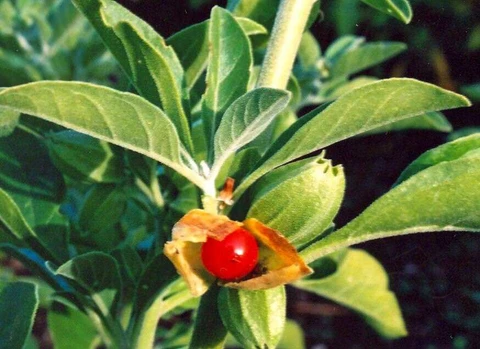
Withania somnifera — Ashwagandha
Scan to view Ashwagandha